Many older, heavily muscled, or flat-faced dogs have trouble staying cool. A cool coat can make the difference between comfort and overheating.
A dog cool coat from Made by De is made of synthetic chamois. The great thing about chamois is that it soaks up water so it helps dry your dog after swimming too.
A dog cool coat can help your dog feel their best, even when it's hot outside. If you get one from Made by De, it can fit well because it's made for them.
Hiking with your dog can be much more fun if they aren’t at risk of overheating. A cool coat helps keep your dog comfy and safe.
Adventure doesn't have to be put on hold because of the summer heat if your dog has a cool coat to keep them comfortable.
If you have a high-drive dog like this one, you might have noticed that they’ll work until they drop. Taking the precaution of putting a cool coat on them can help keep them safe from heatstroke.
Dogs can't cool themselves off like we can. A dog cool coat can do the cooling for them. If you're in the market for a dog cool coat, take a look at Made by De.
How should a dog coat fit?
How should a dog coat fit?
Dog coat fit. You’ve decided your dog needs a dog coat. But how do you get the right fit? That’s not as simple to answer as you might think. Dog clothes are a lot like people's clothes. People's clothes fulfill different needs; function, comfort, style, identification, climate……….. Dogs’ clothes do the same! No matter what function they are performing, however, dog coat sizing is important.
Your dog wants to be comfortable.
The dog coat has to feel good for your dog if they will wear it instead of shred it. They hate tight clothes just like we do (if we’re honest). Back in the day, tight jeans were the trend. The problem is that you couldn’t bend, sit or move very easily, although we wore them anyway because it was cool! But secretly, we couldn’t WAIT to put those comfy pants back on. Dogs, not feeling the need to be fashion conscious, don’t put up with the discomfort. They insist on a coat that isn’t binding and doesn’t restrict movement. A dog will run away, refuse to move with the coat on, or chew it to get it off rather than deal. So a good fit is important.
A comfortable dog will be able to work better. If they aren’t overheated because of a dog cool coat, that helps. And if that cool coat fits, they’ll be able to move like they aren’t wearing anything at all.
How do you get a good fit?
Coats for dogs come in lots of different styles, so measurement practices vary. The most important thing is that the coat is proportionate to your dog. And serves the function it needs to. Usually, the maker will have a set of standards they use to make a coat. You’ll want to use the specific standards of your intended maker to get the proportions right. If they don’t have them posted or aren’t sure if you are getting it right, contacting the company can be a great idea.
Length
A good place to start is length (A in the diagram below) since the coat proportions generally are based on length. A too short or too long coat is likely to have fastenings or other features in the wrong place. A couple inches in front of the tail might not be a problem. Or you may want a few extra inches if you are considering a coat to keep that hind end dry and warm. However, you should specify the actual length plus or minus to be clear.
Neck
The neck (B in the diagram) needs to have enough room but not too much to feel good. A couple of fingers should fit between your dog and the neck of the coat. If the neck is too big, the coat will hang low over the shoulders and get in the way of movement.
Chest or girth
Chest or girth (C in diagram) is the third measurement that is important. If the coat won’t fit over the ribcage or just barely closes, your dog won’t want to move (remember tight jeans?) if you can even get the coat to stay on. Again, you should allow at least a couple of fingers between your dog and the coat for movement.
Other considerations
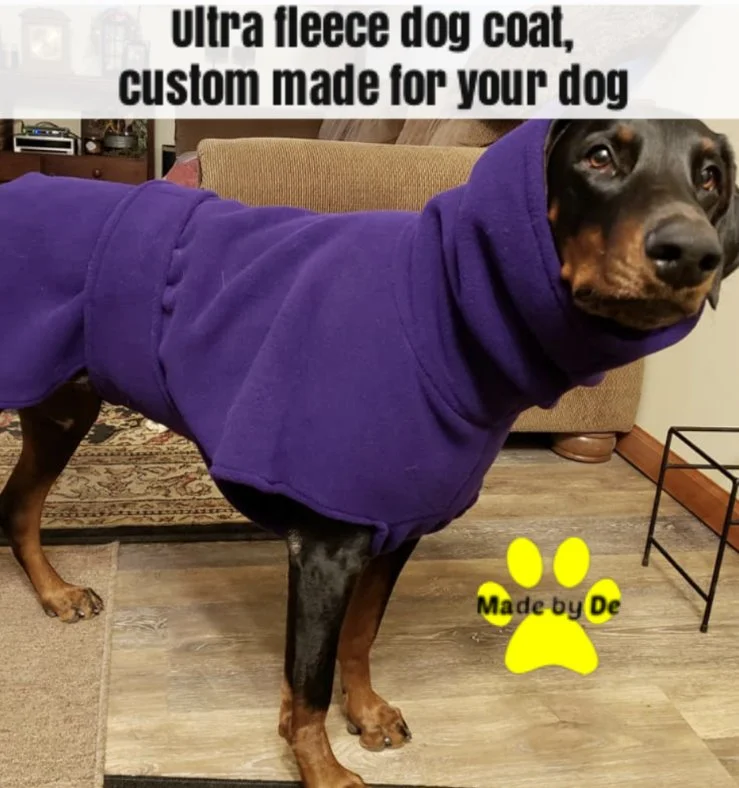
The shoulders should have enough clearance that your dog can walk, run, jump, etc., with ease. Measurements for special features like a hood, pajamas, etc., need to be considered on a case by case basis. The key is to make sure that the garment, whatever it is, does not restrict your dog. There are lots of options for dog coats out there. You may be able to find a great fitting coat that is readily available. Or you might need to consider having a custom dog coat made for your dog. Whatever you decide to do, you will have more success in helping your dog if you watch fit carefully.
Observe your dog. Their nonverbal communication will tell you quite a bit about what they think and how they feel.
A dog coat should cover all the parts it’s supposed to and none of the parts it isn’t.
I make custom dog coats. This is the system I use. If you’re looking for a quality dog coat for your canine friend, go to my website, Made by De, to find out more.
Don't forget to sign up for my insider group here. You'll save 20% on all your orders from Made by De!
Have more fun with your dog this summer with a dog cool coat.
Your dog needs a cool coat so they can play instead of wilting in the heat. Keeping your pup cool can help prevent heatstroke too. Read on for more information about how a dog cool coat works to help your best friend.
Why does your dog need a cool coat?
With the warmer weather of summer, you and your dog will be spending more time doing stuff outside.
– Hiking
– Outdoor agility trials
– Playing at the dog park
– Bike rides
– Hanging out
The more your dog does, the more they build body heat. With the already warmer weather, They can reach the level of overheating pretty quickly. A cool coat can help keep them comfortable when their own defenses are beyond their limits.
But can’t my dog cool itself off?
As much as you like trading in your jackets and boots for shorts and sandals, your dog can’t just shed that fur coat to cool off. Their natural mechanisms are pretty limited. To decrease body heat, dogs
– Sweat, limited to pads of feet
– Pant
– Self-limit activity
– Find a cool spot
This only helps so much. The more active your dog is, the less their defenses can help, so your dog gets hot. A dog cool coat helps decrease body heat, so the heat doesn’t build as much.
Options
In the last several years, many creative options for keeping your dog cool have appeared on the market. Cool coats have become more popular, with several different types available. Here are a few.
Evaporative cooling – Soak the coat in water and let it dry, changing the temperature by several degrees.
Reflective – preventing heat by reflecting the sun’s rays away from your dog.
Thermoregulatory – space-age technology designed to regulate the temperature of your dog experiences.
Results vary, depending on preference, climate, activity, etc.
Made by De coats use evaporation
Evaporative cool coats are a great option since they are inexpensive and effective. Evaporation has been scientifically proven to decrease the air temperature. If you have something damp, you can put your hand close to it and actually FEEL the lower temperature. When a damp, cool coat is placed on your dog, they feel the coolness too. You can watch the panting and restlessness slow down right before your eyes.
Made by De dog cool coats
Take a look at my website for more information about cool coats. I make a variety of cool coats from synthetic chamois. Each one is made just for your dog, so the fit is fantastic! This fabric type is durable, lightweight, and holds onto enough water to keep it damp for hours without being drippy. Pretty cool stuff! And unlike real sheepskin chamois, it doesn’t get brittle and stiff. You can let it air dry and then fold it up when you’re not using it.
A dog cool coat can help your dog have more fun because they stay cool and comfortable.
Great Fit dog diapers; why are they better?
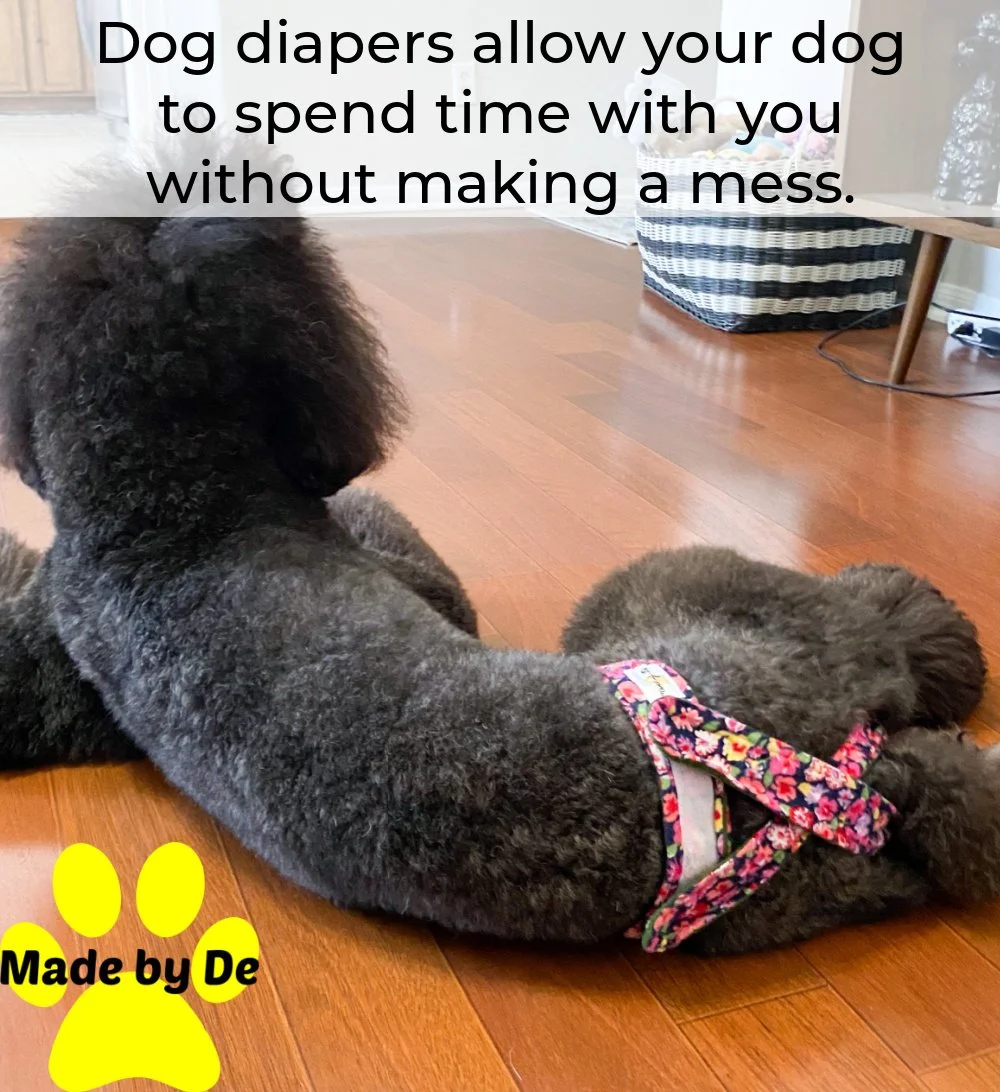
When your dog needs a diaper, you want it to be easy for you to put on, comfortable for them to wear and effective at containing the mess.
Does your dog need a diaper?
Maybe your dog doesn’t need a diaper, also known as dog britches. If that’s the case, this post isn’t for you; at least not right now. But if you have a female in heat or an incontinent dog, boy or girl, you might find that dog diapers can make your life and theirs better.
Heat cycles and incontinence can be really smelly and messy, not to mention the stains that can be left behind. A diaper helps contain that mess. Find out more about senior dog incontinence here.
Your dog should be able to move freely, as they weren’t wearing anything at all.
What choices do you have in dog diapers?
There are several styles and makers of dog diapers out there. Some are disposable and some reusable. why does it matter which ones you get?
Disposable diapers are single use, which can get expensive and fill up the landfill. Plus, they don’t fit very well and make that “plasticy” sound, so many dogs hate them.
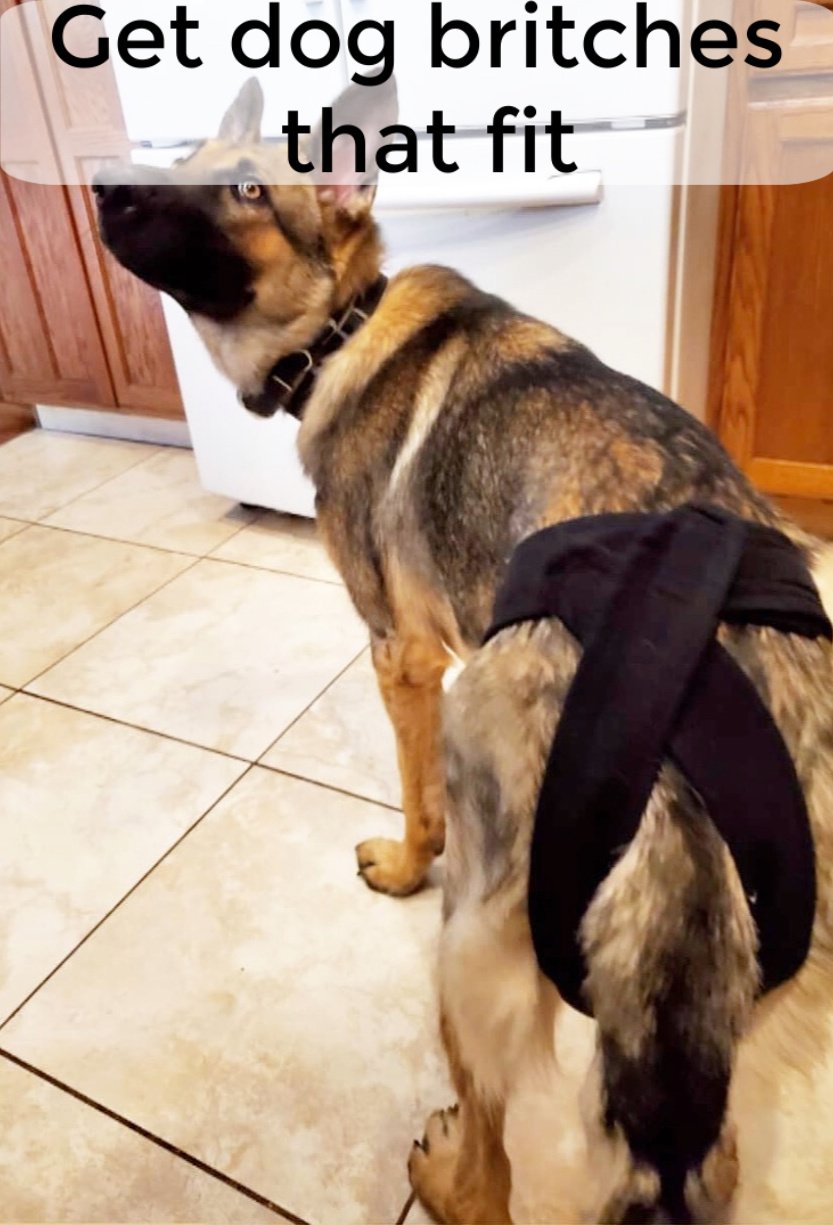
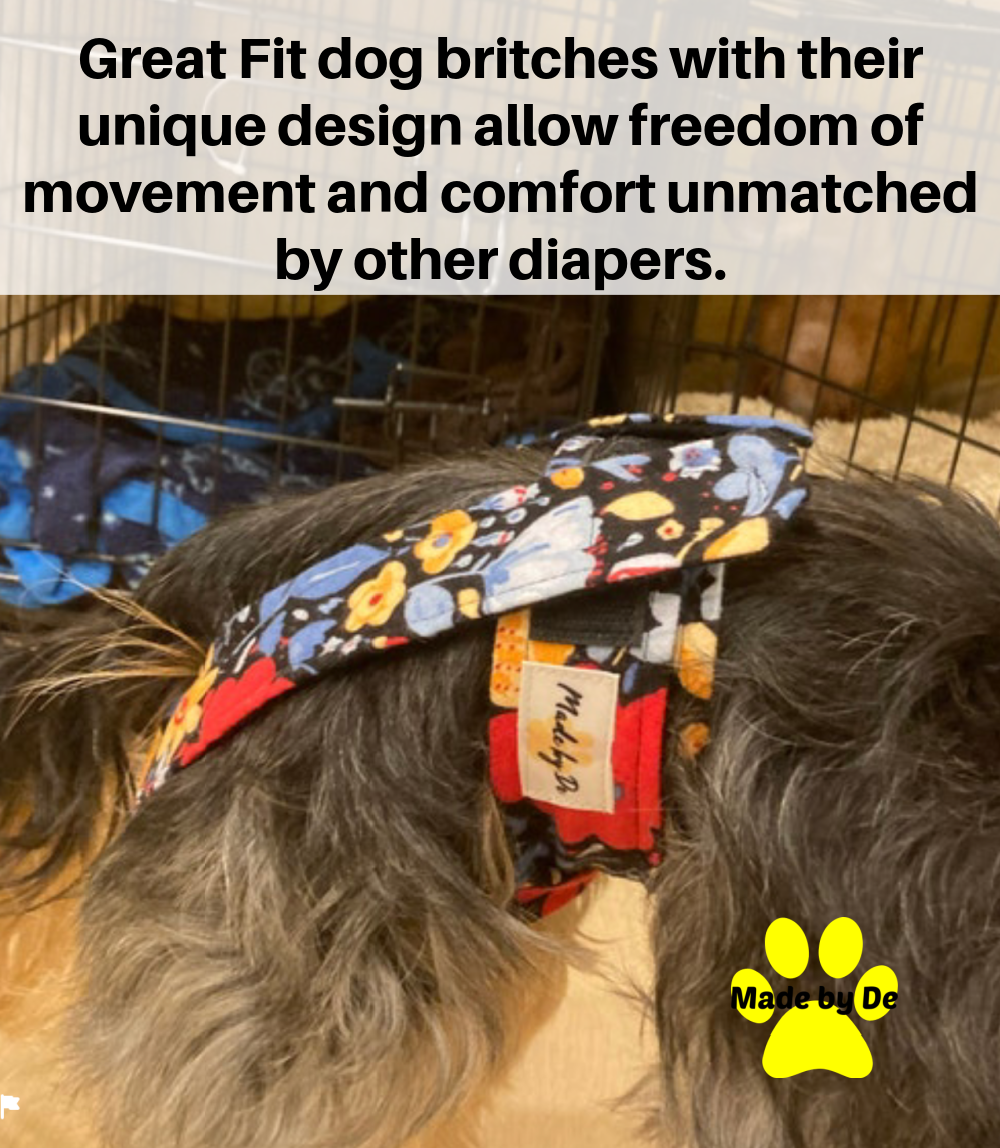
Reuseable diapers are usually made of some type of fabric. Some of them are pre-sized, so you select the closest thing. Others, like Great Fit dog britches, are made just for your dog so you can get the best fit. These diapers generally allow airflow and don’t make “that“ sound which most dogs hate.
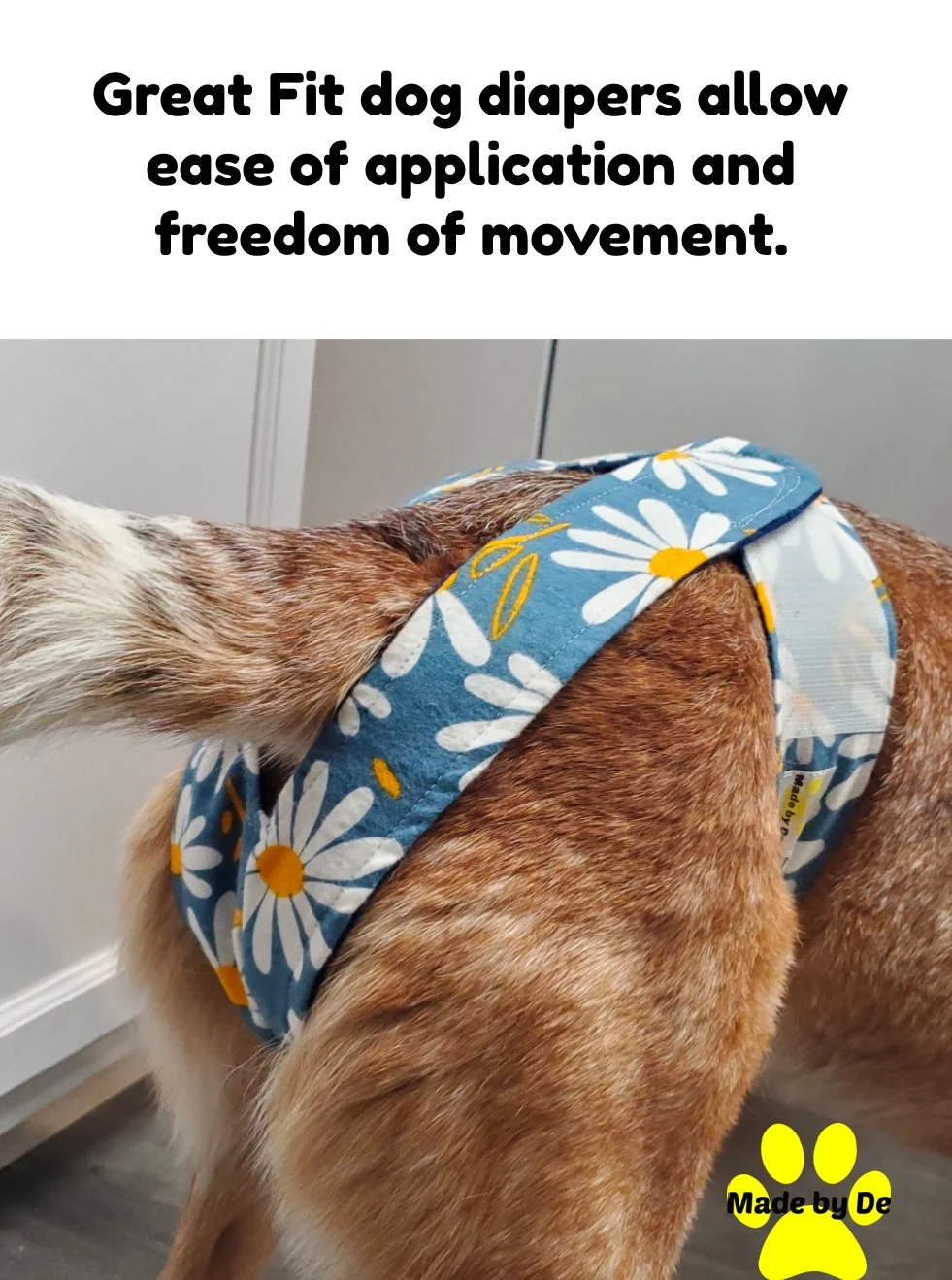
Dog diapers should be comfortable for your dog to wear. They shouldn’t rub anywhere and your dog should have full range of motion. With Great Fit dog diapers, they won’t have to have tails pulled through a hole either.
How Great Fit dog diapers work.
Most dog diapers have a hole that you put the tail through. Once the tail has been pulled through, the diaper usually fastens around the waist.
Great Fit dog diapers wrap around the waist first. Then the panel under the stomach is pulled up between the legs. The attached straps go around the tail and fastening at the waist on top. These straps make it so that the tail doesn’t have to go through a hole at all; much more comfortable for your dog.
The waist band is positioned in front of the hip bones to anchor instead of anchoring on the tail. That makes Great Fit dog britches ideal for dogs without tails too!
The forward position allows your dog’s range of movement to be unrestricted. And the variable strap positioning allows greater adaption for the build of your dog. They can be crossed for a lean, muscular dog or straight for a more stout dog. Change them as needed to find the best fit.
Made by De dog diapers work for dogs without a tail as well as they work for dogs with big fluffy tails due to their unique design.
How to order Great Fit dog diapers
You can order them on my website, www.Madebyde.com, The price is for all sizes so that we can focus on the correct fit and make sure you get a quality product for your dog to wear. I make each set custom for the intended dog using measurements you provide. And if we need to fine tune the fit, I offer free alteration too!
When you order, be sure to send measurements according to the diagram above. A photo with measuring tape or ruler that shows length from waist to base of tail is also helpful and can be emailed to coatsmadebyde@gmail.com.